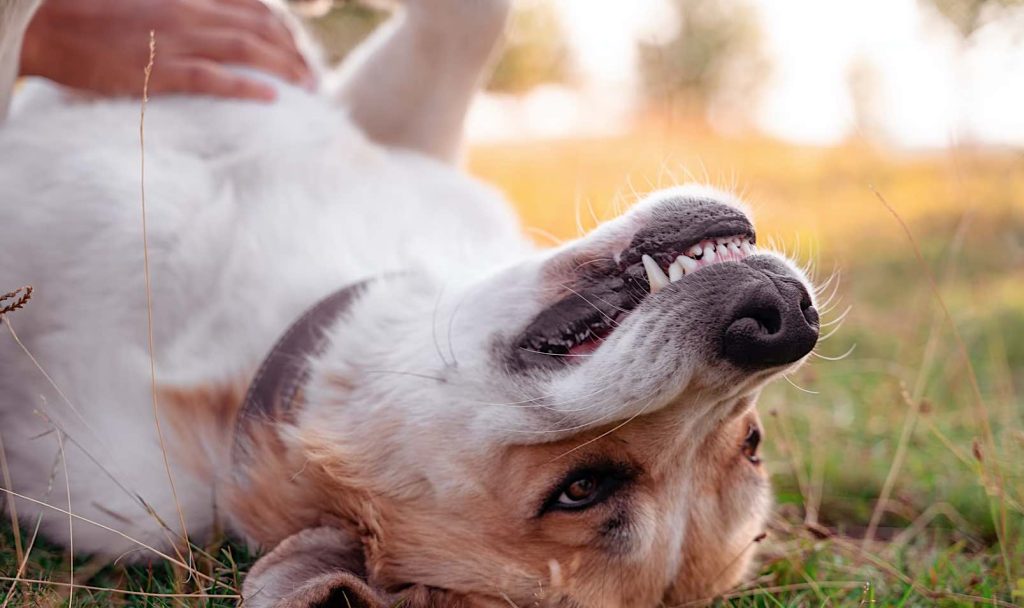
Dogs became ‘man’s best friend’ because of a gene that lowered their stress and made them more relaxed around people, according to new research from Japan.
Descended from wolves, the domestication of dogs which enabled their special relationship with humans has baffled evolutionary experts for decades.
Now, Azabu University thinks they have found the solution. Dogs carry two mutations of a gene known as MC2R (melanocortin 2 receptor), which produces the hormone cortisol–nature’s built in alarm system released during fear or anxiety.
Dogs were born from wolves digging up trash left behind by humans at the edge of settlements. Their offspring became more confident and moved closer to their parents over the years.
Humans began to see the animals as allies, and started training them to become better hunters and shepherds.
“It may have become necessary through the process of domestication for dogs to gaze at humans for instruction and initiate communication to build a more successful relationship,” said corresponding author Dr. Miho Nagasawa. “Because stray dogs that are not brought up in human households show this characteristic, it has been previously suggested there is a genetic component involved. Our results support this hypothesis.”
To investigate the phenomenon Dr. Nagasawa and colleagues ran experiments in which 624 domestic dogs were split into ancient and modern (general) breeds.
The ancient group consisted of those considered genetically closer to wolves such as the Akita and Siberian Husky. Others, such as gun dogs, mastiffs and Jack Russell terriers, are more distantly related. All participants were recruited voluntarily from their owners.
They found the ancient group felt less attached to the testers than the latter, and it was due to the MC2R variants.
” We focused our research on old dog breeds in order to study breed-related differences in cognitive ability and social interaction,” said Nagasawa.
“In a problem solving task, ancient breeds showed a lower tendency to look back at humans than other European breeds.”
Blood samples showed changes to the MC2R gene were associated with correctly interpreting gestures and gazing at the experimenters more often.
There were no other differences, including those for the bonding hormone oxytocin or another related to hyperactivity.
Their research was published in the journal Scientific Reports.
” The results showed both groups are capable of understanding gestures and adapting their responses appropriately. However, in the problem solving task .”
the general group displayed higher eye contact behavior.
“This suggests the capability of dogs to understand human commands and adjust their
own behavior accordingly evolved early in the domestication of dogs. The stronger tendency of gazing at humans, as tested by the problem solving test, was a desirable characteristic that was intentionally chosen for, through human-selected breeding, after dogs had evolved.”
Man’s first best friend was a grey wolf that made contact with its first human companions about 33,000 years ago, somewhere in south east Asia. About 15,000 years ago, a small pack of domesticated dogs began trotting towards the Middle East and Africa.
The species, known as Canis lupus familiaris, made it to Europe about 10,000 years ago, when humans began to build farmsteads and villages and erect walls.
Dogs helped to keep watch and herd first flocks – the DNA blueprints for the adventure outline the details.
SHARE This Fascinating Discovery to Your Pack on Social Media…

Leave a Reply