Table of Contents
How to Feed a Pitbull
There are several ways to feed your pitbull as a puppy and later as a full-grown dog. No feeding method is better or worse than the other, if quality is taken into account. Besides the preferences of the dog, it is primarily up to the owner what he prefers.
Pitbull puppies should initially be fed at least three to four times a day. The manufacturer’s recommendations on the amount of food provide an approximate guide, but the requirements vary from dog to dog.Severe overweight should be avoided, as it can lead to permanent structural damage in young dogs. However, keeping puppies skinny is just as bad as it used to be. In the meantime it is known that dogs that were kept too skinny when they were puppies will later have greater problems in coping with stress. They become more sensitive to stress.
General Recommendations
The health of a dog is fundamentally linked to nutrition. Therefore a food should have a high meat content, be appropriate to the species and balanced. The right amount of food depends on age and activity. Here you should follow the recommendations of the manufacturer.
A puppy should receive 3 – 5 meals a day. For the adult American Pitbull Terrier two portions a day are sufficient.
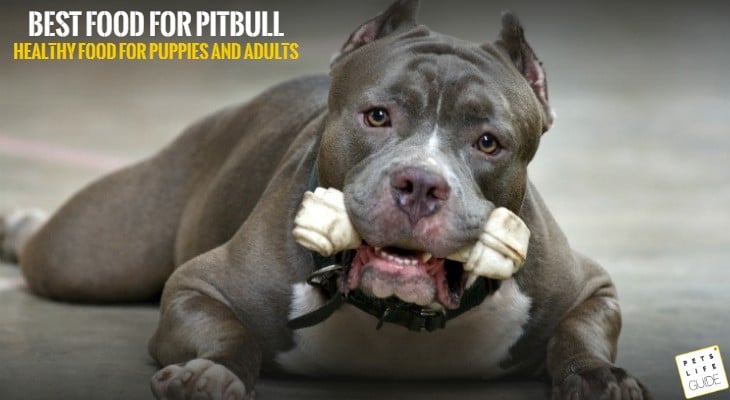
Treats and chewing bones can be given occasionally, especially as a small reward for in between.
Types of Dog Food
Ready-to-Eat food
Ready-to-eat food is practical to handle and, ideally, contains all the nutrients a dog needs. Depending on the method of production, a distinction is made between dry food, moist food and semi-moist food. As a rule, these are complete foods that cover the nutritional requirements of the dog. However, there are also individual and supplementary feeding stuffs that have to be mixed with other food for feeding, e.g. pure meat in tins, flakes for mixing, etc.
Dry Food
For the production of dry dog food all ingredients are dried, ground and extruded under humidity, heat and pressure. Severe overeating should be avoided, as it can cause permanent skeletal damage in young dogs. However, keeping puppies skinny is just as bad as it used to be. In the meantime it is known that dogs that were kept too skinny when they were puppies will later have greater problems in coping with stress. They become more sensitive to stress.
Semi-moist food
There are few semi-moist complete food types. An increased moisture content is noticeable in the consistency of the bites, which are not solid and crumbly, but softer, similar to chewy candy. Well-known manufacturers are Bosch and MAC’S, who both mark their semi-moist food with the designation “Soft”.
Moist food
Wet food is preserved by heat, so that additional preservatives would not be necessary. The ingredients are mixed and filled into cans or other packaging. These are then heated and sealed so that they are sterile. Moist food is mainly offered in cans, bowls and pouches. For feeding, a can is simply opened. A disadvantage is the rather high amount of waste. Wet food contains around 70-80% moisture. This means that the dog has to drink less than when feeding dry food. But it also has a lower nutrient density which means that the dog needs to be fed more.
Treats
Whether the treat as a reward or the dried pig’s ear as an occupation – there is also a lot to think about. With treats, it is worth taking a look at the ingredients, because if you pay attention to healthy dog nutrition, you should not feed any waste in between. Often there are things in it that nobody wants to have in the dog food like animal by-products and baker’s by-products. Bright colors are an indication of unhealthy dyes, unless plant colors like beet or spinach are mentioned on the packaging.
Snacks are often produced under the influence of unhealthy substances. They are dried in chemical chambers because it is faster or are even bleached with chemicals like buffalo skin bones. Responsible owners pay attention to quality and choose at least “Made in USA”, for dry goods preferably “air-dried”.
Home-made dog food
The trust of the dog owners to the food industry is not large, because only few feed enterprises make public, what exactly is in the finished food. Therefore, self-prepared food becomes more and more popular, because here you know exactly what you are feeding.
Cooking meat and vegetables for the dogs was common practice in the past. Opponents argue that cooking meat destroys enzymes and denatures amino acids. Nevertheless, experience has shown that cooked meat is easily digestible and is particularly well tolerated by dogs with a very sensitive gastrointestinal tract. The cooking process also kills potential infectious agents.


Leave a Reply